
Facial fat grafting: how much stays? Retention rates from research
How much grafted fat stays in the face can only be answered as a range. Some of the fat moved from another part of the body to the face does not remain, so studies measure what is left against what was grafted. This guide gathers research figures overall, by fat processing, by area and over time, to help you prepare questions for a physician. It is not advice on how much to graft.
Overall: a mean near 47%, with wide differences between studies
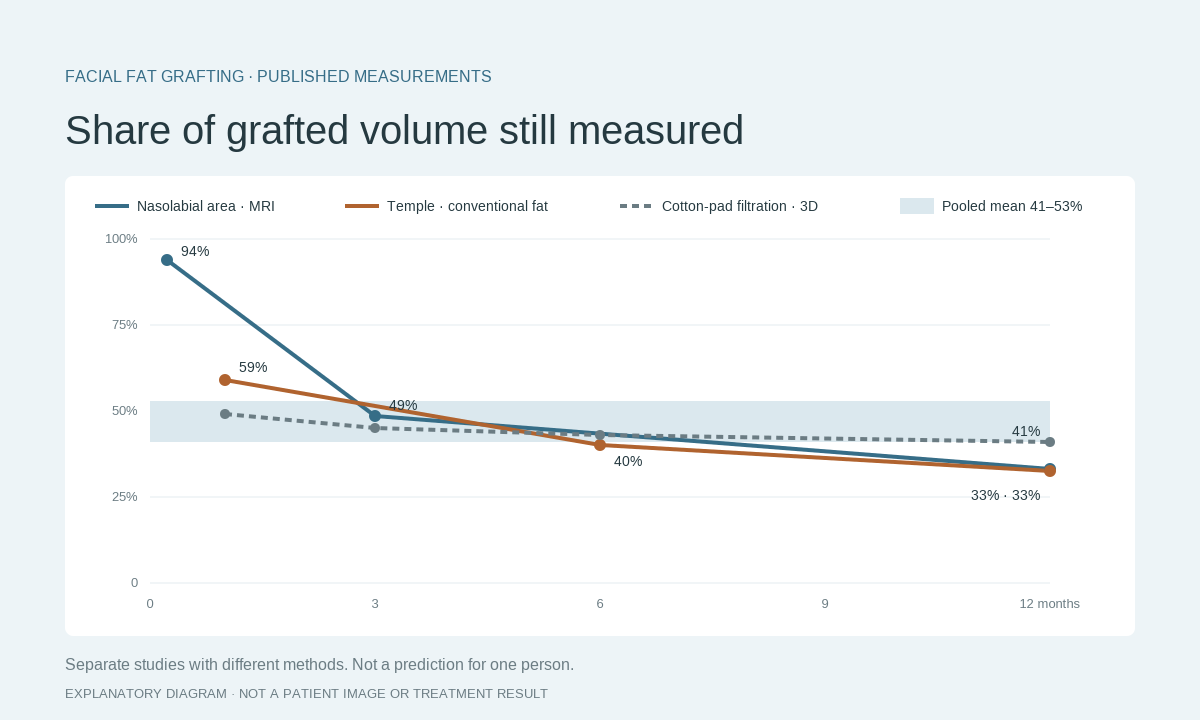
A systematic review by Lv et al. (published 2021) combined 27 studies and 1,011 patients. Objectively measured retention averaged 47% (95% confidence interval 41–53%), but individual studies ranged from 26% to 83%, mean follow-up from 3 to 24 months, and the measurement method clearly affected the figures.
The 41–53% interval describes uncertainty in the average, not the range one person will see. Taken linearly, 1 mL of grafted fat would leave about 0.47 mL by this average, but that does not say how many millimetres the surface rises, and an individual result may be far from the mean.
How the fat is processed changes the figures
Wu et al. (2018) randomized 63 patients with facial asymmetry into three groups of 21 by processing method; 30 completed follow-up. 3D imaging at months 1, 3, 6 and 12 found mean retention of 49, 45, 43 and 41% with cotton-pad filtration, 41, 38, 36 and 34% with centrifugation, and 37, 34, 31 and 31% with sedimentation.
The participants were a young group treated for asymmetry, and not everyone was followed up, so the figures compare processing methods within that study rather than apply to every area of the face. The question to ask is how the clinic prepares the fat.
By area: cheeks, temples and forehead
Cheeks and midface: Meier et al. followed 33 patients (66 sides) for a mean 16 months. A mean 10.1 mL was grafted per side and 3.3 mL of added volume was measured, a mean retention of 31.8%. Gerth et al. followed 26 women (52 sides) for a mean 17 months: 8.88 mL grafted, 3.71 mL measured, or 41.2%.
Temples: Zhang et al. found conventional fat retained at 58.9% at 1 month, 39.9% at 6 months and 32.6% at 12 months; fat prepared as SVF-gel at 65.4, 50.4 and 41.2%. Huang et al. reported 65.7%, but patients had a mean 1.5 sessions, so this cannot be compared with a single session. Forehead: in 17 patients measured in 3D, retention was 46.71% with botulinum toxin given alongside and 39.12% without, but the toxin was not randomized, so it cannot be concluded that toxin makes fat last longer.
Reference: Meier et al. (2009): long-term volume retention of midface fat grafting — Archives of Facial Plastic Surgery · Gerth et al. (2014): midface fat graft volume with 3D imaging — Aesthetic Surgery Journal · Zhang et al. (2022): SVF-gel and Coleman fat in the temple, 3D laser scanning — Frontiers in Surgery · Huang et al. (2018): fat grafting to the temple, 96 patients — JAMA Facial Plastic Surgery · Forehead fat grafting with and without botulinum toxin, 3D volumetric analysis (2019)
Time and body weight
Liao et al. measured grafted fat in the nasolabial area directly with MRI: 94.1% at 7 days, 48.7% at 3 months and 33.1% at 1 year. What is seen early is therefore more than the long-term result, and studies disagree on when the volume becomes stable.
A 5-year follow-up of 12 patients found that visible facial volume was associated with weight gain, while the grafted volume was not significantly associated. The study is too small to give a formula, but it is a reason to record body weight before grafting and at follow-up.
Reference: Liao et al. (2022): nasolabial fat graft retention measured by MRI — Quantitative Imaging in Medicine and Surgery · Facial fat grafting at five years with 3D surface imaging (2025) — JPRAS
How it is measured, and figures for the chin and lips
3D surface imaging measures the change in the skin’s shape; MRI or CT measures the fat tissue beneath. The two kinds of figure should not be compared directly. Lobato et al., in 40 chin patients, found that absolute volumes from CT and from smartphone photographs differed, but the change from before treatment to 6 months was not significantly different between them.
Basile and Basile studied chin fat grafting in 42 patients and reported a mean projection gain of 8.9 mm at 4 weeks and 7 mm at 6 months (range 3–11 mm), without the grafted volumes needed to work out a per-cc figure. For the lips, a study of 40 patients who also had a lip lift found that the volume gained from fat approached zero by about 22 months, but only 3 patients were followed beyond 18 months, so no conclusion can be drawn.
Reference: Lobato et al. (2023): CT and smartphone photogrammetry after chin fat grafting — Aesthetic Surgery Journal · Basile and Basile: chin augmentation with fat, 42 patients — Plastic and Reconstructive Surgery · Lip lift with and without fat grafting in facial feminization, 3D volumes (2026) — ASJ Open Forum
Fat and filler: the figures do not compare directly
Fat grafting is a procedure that takes fat from another part of the body; filler is an injected gel. The “percentage retained” for fat and the “volume measured per millilitre” for filler come from different kinds of study, different time points and different measurements.
If you are choosing between the two, ask a physician about every option, including not treating for now, the risks of each, recovery and follow-up.
- How does the clinic prepare the fat?
- At how many months will the result be assessed?
- If another session is needed, when will that be judged?
- How might a change in body weight affect what is seen?
Talk to a physician with a picture of your own face
The amount, placement and number of sessions must be assessed by a physician from a real examination. The figures here help explain why results differ; they are not for setting a dose.
DooDeeClinic lets a physician simulate fat grafting on a 3D model of the person’s own face, showing only part of the grafted volume, close to the research average, to explain it during a consultation. The picture is a simulation for communication, not a guaranteed result.
Sources
- Lv et al. (2021): fat graft retention in the face, systematic review and meta-analysis — Aesthetic Plastic Surgery
- Wu et al. (2018): fat processing methods and facial graft retention, randomized study — JAMA Facial Plastic Surgery
- Meier et al. (2009): long-term volume retention of midface fat grafting — Archives of Facial Plastic Surgery
- Gerth et al. (2014): midface fat graft volume with 3D imaging — Aesthetic Surgery Journal
- Zhang et al. (2022): SVF-gel and Coleman fat in the temple, 3D laser scanning — Frontiers in Surgery
- Huang et al. (2018): fat grafting to the temple, 96 patients — JAMA Facial Plastic Surgery
- Forehead fat grafting with and without botulinum toxin, 3D volumetric analysis (2019)
- Liao et al. (2022): nasolabial fat graft retention measured by MRI — Quantitative Imaging in Medicine and Surgery
- Facial fat grafting at five years with 3D surface imaging (2025) — JPRAS
- Basile and Basile: chin augmentation with fat, 42 patients — Plastic and Reconstructive Surgery
- Lobato et al. (2023): CT and smartphone photogrammetry after chin fat grafting — Aesthetic Surgery Journal
- Lip lift with and without fat grafting in facial feminization, 3D volumes (2026) — ASJ Open Forum
Visualization supports a consultation. It does not guarantee treatment outcomes. Assessment and advice remain the physician’s responsibility.