
Masseter botox: how many units, and how much narrower? What trials measured
People who search for masseter botox units usually want two answers: how much is used, and how much narrower the face becomes. Placebo-controlled randomized trials give both, for the participants they selected. This guide summarizes those figures, explains why one product’s Units cannot be compared with another’s, and separates jaw treatment from wrinkle treatment. It is for preparing questions, not a dosing guide.

What a botox Unit is
A Unit (U) measures the potency of one botulinum toxin product. The BOTOX Cosmetic prescribing information states that its Units are specific to that preparation and cannot be compared with or converted into the Units of another product. The Unit figures in this guide are therefore for onabotulinumtoxinA in the trials cited, and no other product.
The volume of saline used to dilute the product says nothing about the dose or its effect on the face. When you talk to a clinic, ask for the product name and the number of that product’s Units, not only the number of cc or injection points.
Reference: BOTOX Cosmetic (onabotulinumtoxinA) Prescribing Information, revised 10/2024 (PDF)
Masseter treatment: the width measured in a phase 2 trial
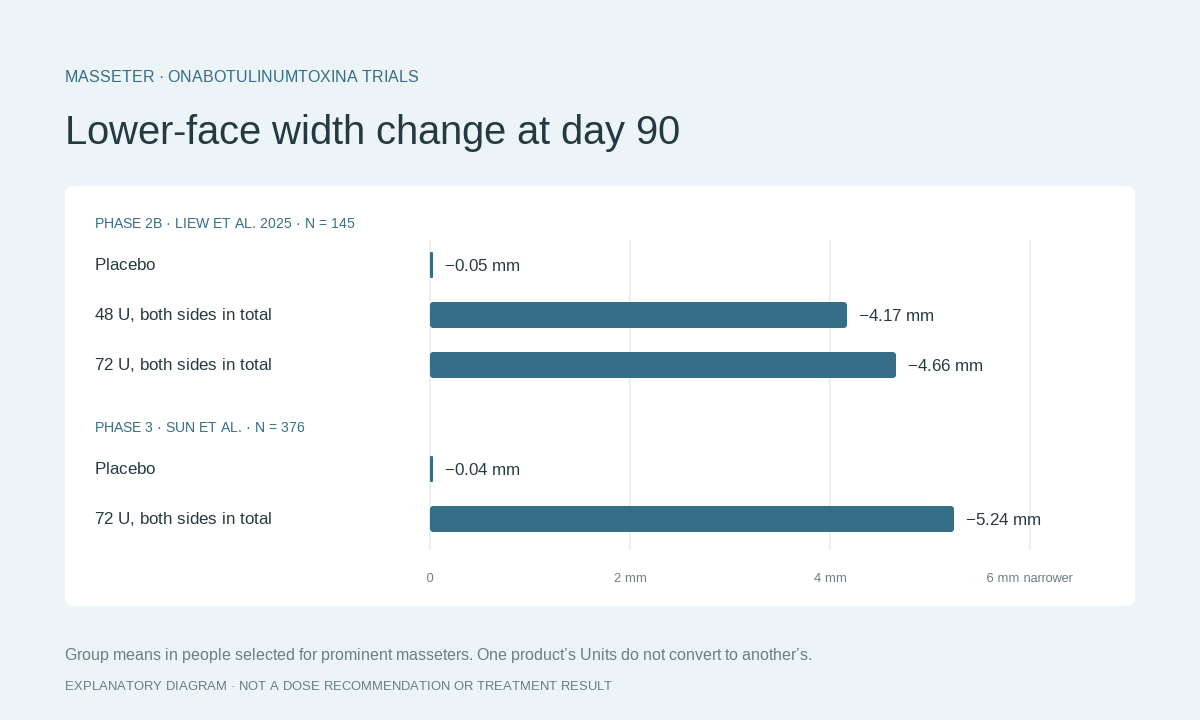
Liew et al. (2025) studied 145 participants with prominent masseter muscles, given placebo or onabotulinumtoxinA at two doses: 48 Units and 72 Units in total across both sides. At day 90, lower-face width had narrowed by a mean 4.17 and 4.66 mm respectively, against 0.05 mm with placebo.
The 48 and 72 Units are totals for both sides, and 4.17–4.66 mm is the overall width of the lower face, not how far each side receded. The higher dose did not give much more than the lower one, so the trial gives no rule for how much narrower a face becomes per added Unit.
A phase 3 trial: the same dose, a different average
In the phase 3 trial by Sun et al., 376 participants took part, 283 given the drug and 93 placebo, all with marked to very marked masseter prominence. At day 90 the group given 72 Units in total across both sides had a mean lower-face narrowing of 5.24 mm, against 0.04 mm with placebo.
That is the same dose as the 72-Unit group of the phase 2 trial, yet the means differ by about 0.6 mm. This difference between groups of participants is uncertainty worth knowing about, and one person’s result may sit far from both averages.
Reference: Sun et al.: onabotulinumtoxinA for masseter muscle prominence, phase 3 — Aesthetic Surgery Journal
Reading the masseter figures correctly
All of these are group means at day 90, in people selected because their masseters were prominent. The trials cited here do not say when the change becomes visible or how many months it lasts; ask a physician about timing, for the product that will actually be used.
Lower-face width comes from bone, fat and muscle together. A toxin injected into the masseter acts on the muscle, so a physician needs to assess what the width you are concerned about comes from, and which approach fits.
- In the trials, Units are totals for both sides, not per side.
- Millimetres are overall width, not how far each point recedes.
- Measured at day 90; not how long the effect lasts.
- Participants had prominent masseters; not every face shape.
Botox for wrinkles: measured by scores, not millimetres
The BOTOX Cosmetic prescribing information covers glabellar lines, crow’s feet (lateral canthal lines), forehead lines and platysma bands of the neck. Results in those studies are measured with wrinkle-rating scales and facial movement, an effect seen while making an expression, so a scan of a neutral face cannot show it fully.
One study measured brow position in millimetres, with a different product, daxibotulinumtoxinA. Two weeks after injection, the brow tail rose by a mean 0.6–0.9 mm, the middle of the brow by 0.5–0.7 mm and its inner end by 0–0.23 mm. These figures do not transfer directly to another product or dose.
Reference: BOTOX Cosmetic (onabotulinumtoxinA) Prescribing Information, revised 10/2024 (PDF) · Solish et al.: brow position after daxibotulinumtoxinA for glabellar lines — Aesthetic Surgery Journal
Before deciding, talk to a physician
Let a physician assess whether injection suits you, which product and how many Units, and what the risks are. A good answer refers to the product actually used, not to figures from another product.
In DooDeeClinic a physician can simulate masseter treatment on a 3D model of the person’s own face. The change the simulation shows is an approximation based on the group means of the phase 2 trial, not an individual prediction. The simulation is for communication, not a guaranteed result.
- Which product, and how many Units in total for both sides?
- Does the width I am concerned about come from muscle, bone or fat?
- When is the result usually assessed, and how is follow-up arranged?
- What are the risks, and which symptoms should I report to the clinic?
Reference: American Academy of Dermatology: Questions before a cosmetic treatment
Sources
- BOTOX Cosmetic (onabotulinumtoxinA) Prescribing Information, revised 10/2024 (PDF)
- Liew et al. (2025): onabotulinumtoxinA for masseter muscle prominence, phase 2 — Aesthetic Surgery Journal
- Sun et al.: onabotulinumtoxinA for masseter muscle prominence, phase 3 — Aesthetic Surgery Journal
- Solish et al.: brow position after daxibotulinumtoxinA for glabellar lines — Aesthetic Surgery Journal
- American Academy of Dermatology: Questions before a cosmetic treatment
Visualization supports a consultation. It does not guarantee treatment outcomes. Assessment and advice remain the physician’s responsibility.